
Crohn’s disease rarely announces itself. It usually starts as something easy to explain away — a run of looser stools, cramps that come and go, a tiredness that a good night’s sleep does not touch. Because those symptoms overlap with far more common conditions, the average person sees a doctor several times before anyone says the word Crohn’s.
Knowing what the early pattern actually looks like is what shortens that delay.
The four earliest and most common signs
1. Diarrhoea that does not settle
This is the symptom most people notice first. The distinguishing feature is not severity but persistence: a stomach bug clears in a few days, and Crohn’s does not. Diarrhoea lasting longer than four weeks, or that keeps returning over several months, is the clearest early signal.
It is often worse in the morning and after meals. Many people also describe urgency — needing a toilet within minutes rather than being able to wait.
2. Cramping pain, often low on the right
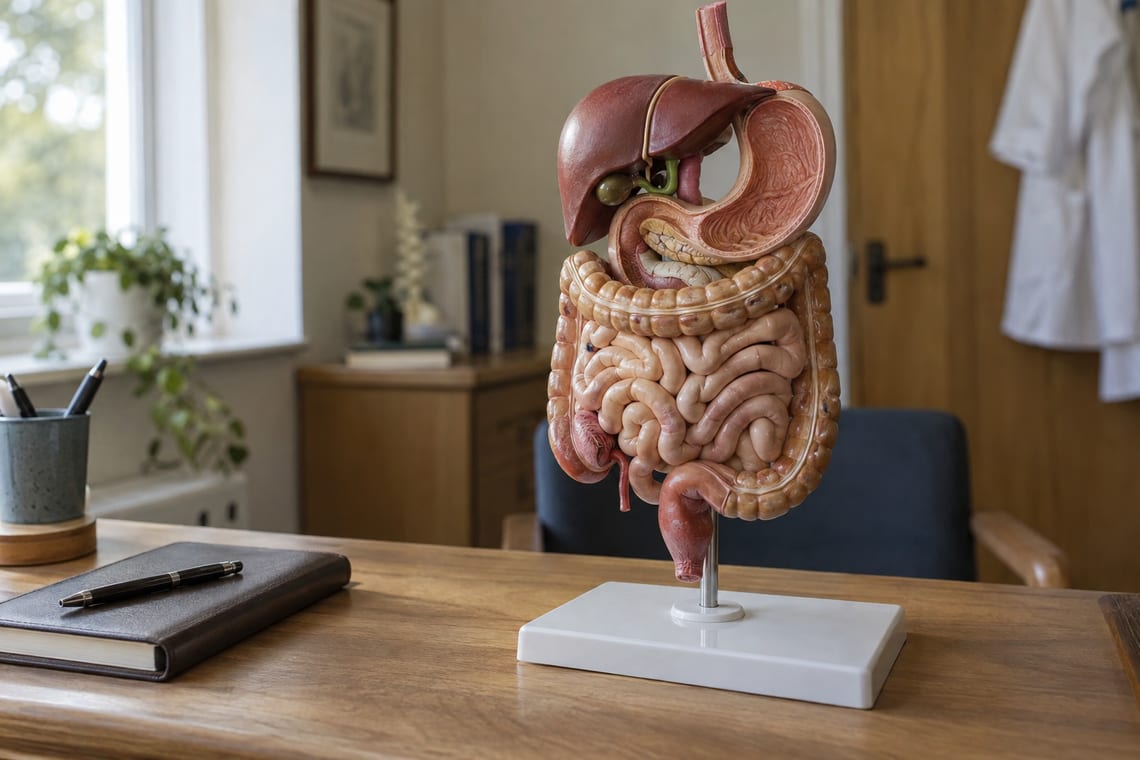
Crohn’s most commonly affects the terminal ileum, the last section of the small intestine, which sits in the lower right of your abdomen. That is why pain there is a classic early sign, although Crohn’s can inflame any part of the digestive tract from mouth to anus.
The pain is typically crampy rather than constant, often worse 30 to 60 minutes after eating, and briefly relieved by passing stool.
3. Losing weight without trying
Inflamed intestine absorbs nutrients poorly, and eating often makes symptoms worse, so people unconsciously eat less. Unintended weight loss — particularly more than 5% of your body weight over a few months — is one of the signs doctors take most seriously.
4. Fatigue that rest does not fix
This is the symptom people most often leave out when describing their problem to a GP, and it is one of the most useful. The fatigue of Crohn’s comes from the inflammation itself, from poor absorption of iron and B12, and from disturbed sleep. It is disproportionate — tiredness that does not match what you have been doing.
Less obvious early signs
Crohn’s is an immune condition, and the first noticeable signs are not always in the gut:
- Mouth ulcers that keep recurring, sometimes appearing before any bowel symptoms
- Blood or mucus in your stool, which can be bright red or make stools look dark and tarry
- A low-grade fever during flares, usually under 38°C
- Reduced appetite and feeling full quickly
- Joint aches, particularly in the knees, ankles and lower back
- Sore, red eyes or light sensitivity
- Tender red lumps on the shins, a skin reaction called erythema nodosum
- Pain, swelling or a sore around the anus — perianal disease is relatively specific to Crohn’s
In children and teenagers, the first sign is sometimes slowed growth or delayed puberty rather than obvious bowel symptoms.
When to see a doctor without waiting
Book a routine GP appointment if you have had diarrhoea, abdominal pain or both for more than four weeks.
Seek medical help promptly, rather than waiting, if you have:
| Sign | Why it matters |
|---|---|
| Blood in your stool | Suggests inflammation or ulceration, not simple IBS |
| Unintended weight loss | A marker of malabsorption and active disease |
| Symptoms that wake you at night | Functional conditions like IBS rarely do this |
| Fever alongside abdominal pain | May indicate infection or an abscess |
| Severe, constant or worsening pain | Can signal a blockage or perforation |
| A sore, lump or discharge near the anus | Perianal Crohn’s needs specialist assessment |
Night-time symptoms are one of the most useful dividing lines. IBS almost never wakes people; inflammatory bowel disease frequently does.
The test to ask for
If your GP is weighing up IBS against inflammatory bowel disease, the most useful first step is a faecal calprotectin test — a stool sample that measures a protein released when the bowel wall is inflamed.
It does not diagnose Crohn’s by itself, but it does something valuable: it separates inflammatory conditions from functional ones. A normal result makes IBD unlikely. A raised result is the trigger for referral to a gastroenterologist.
Alongside it, expect blood tests for anaemia, inflammatory markers such as CRP, and nutritional deficiencies including iron, ferritin, B12 and vitamin D. Diagnosis is confirmed later by colonoscopy with biopsies, and often MRI imaging of the small bowel.
NICE recommends calprotectin testing specifically to help distinguish IBD from IBS in adults with recent lower gastrointestinal symptoms, so it is a reasonable test to ask for by name.
Why early diagnosis matters
Crohn’s causes inflammation through the full thickness of the bowel wall. Left untreated over years, that repeated inflammation and healing can cause scarring and narrowing, called a stricture, or abnormal tunnels between the bowel and other organs, called fistulas. Both are much harder to treat than inflammation alone.
Getting a diagnosis earlier means treatment can begin while the problem is still inflammation rather than structural damage. That is the single strongest argument for not waiting out symptoms that have gone on for more than a month.
What happens next
A Crohn’s diagnosis is not what it was a generation ago. Most people reach and maintain remission with modern treatment, and the majority live full working and family lives. Understanding the condition — what it is, what drives it, and what you can influence — is the useful first step.
A note on self-diagnosis. None of these signs are unique to Crohn’s on their own. Persistent diarrhoea, abdominal pain and fatigue have many causes, most of them more common than Crohn’s. The purpose of knowing the pattern is to have a more specific conversation with your GP, not to reach a conclusion without one.